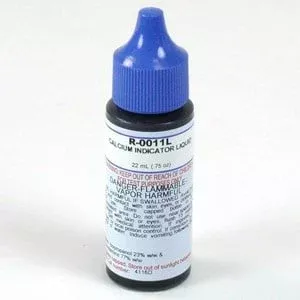
Taylor R-0011L-A-24 Calcium Hardness Indicator – 24 oz Refill
The Taylor R-0011L-A-24 is a 24 oz refill bottle of Calcium Hardness Indicator used in Taylor’s calcium hardness (CH) drop-count test. This indicator is added to a buffered water sample to produce the starting color before titrating with the calcium hardness titrant to reach the test endpoint.
Key Features
- Calcium hardness indicator for Taylor CH (hardness) testing
- 24 oz refill size for frequent testing or service use
- Used with the Taylor hardness buffer and R-0012 titrant to measure calcium hardness accurately
- Helps monitor water balance to reduce scale (high CH) and etching/corrosion (low CH)
How It’s Used (Overview)
- Add the Taylor hardness buffer to your measured sample (per your kit instructions).
- Add R-0011L indicator to produce the starting color.
- Titrate with R-0012 until the color changes to the endpoint to calculate CH.
Specifications
- Brand: Taylor Technologies
- Part Number: R-0011L-A-24
- Reagent Type: Calcium Hardness Indicator
- Form: Liquid
- Size: 24 fl oz
- Application: Pool & spa water testing
Compatibility Notes
- This is an indicator reagent used with Taylor calcium hardness test procedures.
- For a complete CH test you also need the matching hardness buffer (commonly R-0010) and the titrant (commonly R-0012).
Related Products
- Taylor R-0011L Calcium Hardness Indicator (Other Sizes)
- Taylor R-0010 Calcium Hardness Buffer
- Taylor R-0012 Calcium Hardness Titrant
- Calcium Hardness Test Supplies
- Taylor K-2006 Test Kits
- Pool Water Test Kits
Maintenance Tips
- Store reagents in a cool, dry place out of direct sunlight to help maintain accuracy.
- Keep caps tightly closed and avoid cross-contamination between reagents.
- Rinse test cells with fresh water after testing and allow them to air dry to reduce residue.
- Replace reagents that are old or have been stored in extreme heat/cold if results seem inconsistent.